Showing posts with label Astronomy. Show all posts

Sunday, May 20, 2012

Annular Solar Eclipse

It doesn't happen very often, but we witnessed a solar eclipse this evening.
We live a couple of hours north of where we could have witnessed "The
Ring of Fire" effect of a total eclipse, but it was fun nonetheless.  Lynn and
I took our pinhole'd paper out into the backyard and definitely saw the 
effects of the partial eclipse.  It did get noticeably darker for 7:30pm, but sadly
the lights didn't come on automatically and the birds didn't go to sleep!
I was tempted to drive the several hours south, but this satisfied my 
scientific geeky curiosity for the day...

Thursday, August 05, 2010

Valerie's Leaving


Tonight we attended a small going away dinner for our friend,
Valerie, who is moving back to Michigan for a few months.
Our friend Christine, was a fantastic hostess as usual and
since her home is in the middle of wine country near Palisade,
there were tons of stars visible and we saw no less than six
satellites cross overhead. We'll miss Valerie, but she should
be back in the spring.

Saturday, July 10, 2010

Cook Islands Eclipse


Tomorrow afternoon, there will be a total Solar Eclipse that very
few people on Earth will be able to witness. One of those few places
however will be in the Cook Islands. We visited the small nation of
the Cook Islands in 2003 (particularly the islands of Rarotonga and
Aitutaki) and I can't think of too many places where a full eclipse would
be more beautiful. For those who don't know, the Cook Islands are a
small archipeligo of islands about the same distance south of the
equator as Hawaii is north of the Equator and on the same latitude.
It's a truly wonderful place and the people are very friendly toward
travelers. I'd be happy to share my thoughts or any tips to those that
are interested in visiting this paradise!

Monday, June 28, 2010

The International Space Station


The other day at lunch, our friend Judey turned us on to the
fact that the International Space Station (ISS) was going to be
very visible to us over the next few days. All we had to do was
go to the Space Weather Satellite Flybys page, enter our zip
code and it will show you what time the ISS will go over your
house. It works for other bright satellites and space objects
as well, but apparently there are some favorable sun angles
that will light up the ISS through Monday night. The solar
panels and the immense size of the station make it the largest
man-made item orbiting the earth and much easier to see than
a typical satellite. Although it is indeed in orbit, that orbit is
only 200 miles above the surface, making it closer to us than


When I walked outside at around 8:55, I was disappointed
because it was still pretty light. However, I looked due west
and I could see Venus, so I thought there might be a chance
since the ISS was supposed to be very bright. I waited a few
minutes, looked to the SSW and there it was! Like a very bright
satellite (we see those quite a bit just outside of town) moving
toward the NE. I ran into the house to tell Lynn and for a few
seconds, I couldn't find it....but there it was. Right above our
heads. It moved so fast we only saw it for about ten seconds.
It was great though seeing something so big, so far away,
moving so fast. I'm looking forward to seeing it again tonight!


Saturday, May 15, 2010

Camping at Hovenweep


In 2009, only 37,848 people visited Hovenweep National Monument,
making it the 10th least visited Monument in the National Park
system. If that number increases by two for 2010, Lynn and I
can be thanked because we decided to stop here to camp for the
night on our way home. It's a great little park that has a lot of
different Anasazi (Ancient Puebloan) structures, stradeling the
Utah/Colorado border.


Even though we pulled into the small campground at around
5:30, we found a pretty nice little spot, overlooking a nearby
canyon, and Ute Mountain, far to the east. Unlike the past two
nights at Chaco, there was no wind, and the temperatures were
relatively warm.


Apparently, it takes very little to make us happy and we
discovered that we were going to be the first to use the
fire pit that had recently been installed at our site. It
performed like a champ!


Because the weather was so nice, there weren't any clouds, and
we were able to get a spectacular showing of stars. Probably the
best display we've seen since we last wintered on the Ice a few
years ago. The moon was just a sliver in the sky, certainly helping
our view.

Leaving Chaco


A visit to Chaco could take many days to see everything, but
we had to leave, knowing we'll come back someday soon. We
stopped by the Visitor's Center before heading out and now
the old center has been replaced with a temporary yurt. Yurts
are pretty neat buildings but because this yurt is still fairly
small compared to the old Visitor's Center, none of the old
displays, detailing the history of the area were located here.


The old Visitor's Center has been condemned and is scheduled
for demolition. Apparently, it was built on soft clay and when
the remodeling crew went in to start, it was discovered that
the building was unstable. Lynn and I pondered that in a
place where buildings a thousand years old are the attraction,
modern man can't build a structure that will last more than
50 years!


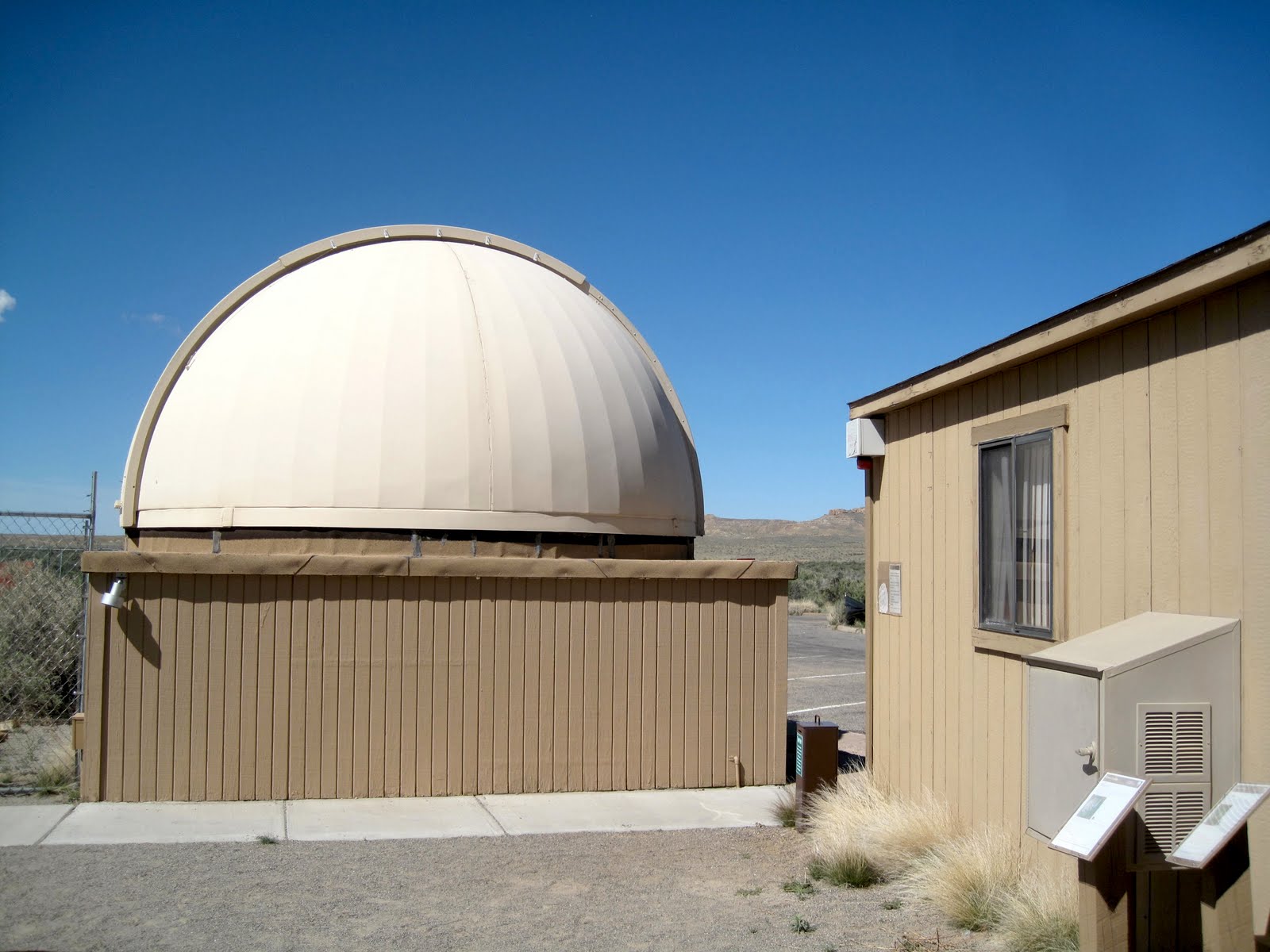
Chaco is a Dark Sky site, meaning that there is very little
light pollution present and is a fantastic place to view the
night sky. As a result, the National Park Service has taken
advantage of that and has a wonderful sky watching
program and even has a great observatory in place. To our
surprise, there was a park volunteer named Bob Bohley that
was operating a telescope at the Visitor's Center this
morning. With a special filter on his telescope, he was
able to show us the Sun and several large flares erupting
off of it's surface. I've seen photos of this before, but never
live on a telescope. It was very interesting and Mr. Bohley
did an excellent job educating everyone that viewed this
sight.


Chaco is one of 20 locations in the United States and one of
890 locations in the world that have been listed as UNESCO
World Heritage Sites. This is an important designation as it
is a protection of Mankind's existence and culture. I think
that Chaco definitely is a good representation of this.

Friday, May 14, 2010

A Day of Exploring


Exploring the Great Houses such as Pueblo Bonito and Chetro
Ketl are always interesting and we could take a week exploring
all the different ruins here, but we were most interested in
visiting ruins that we hadn't visited before. This would involve
a bit of hiking, which we definitely up for. The first site we
checked out was Kin Kletso. At one time, it contained about
55 rooms, 4 kivas and 1 tower kiva. It was actually built by
McElmo phase people who came from the north, late in the
period in which Chaco was occupied.


Much like the other sites at Chaco, almost all of the wood had
to be brought in from miles and miles away. Kin Kletso's beams
were no different. Quite a task for a people who didn't know of
the wheel.


I enjoy seeing the different masonry and doorway styles in
each of the pueblos.


Along the trail, there were a number of petroglyphs. Chaco was
also a huge center of astronomy and we found a circular design
that might have been used to measure the seasons. The sun
would shine at different points of the circle on major astronomical
events of the year such as solstices and equinoxes.


Another small site we visited was Casa Chaquita. It's currently
unexcavated and was probably built around 1100. It was also
a good place to stop for lunch!

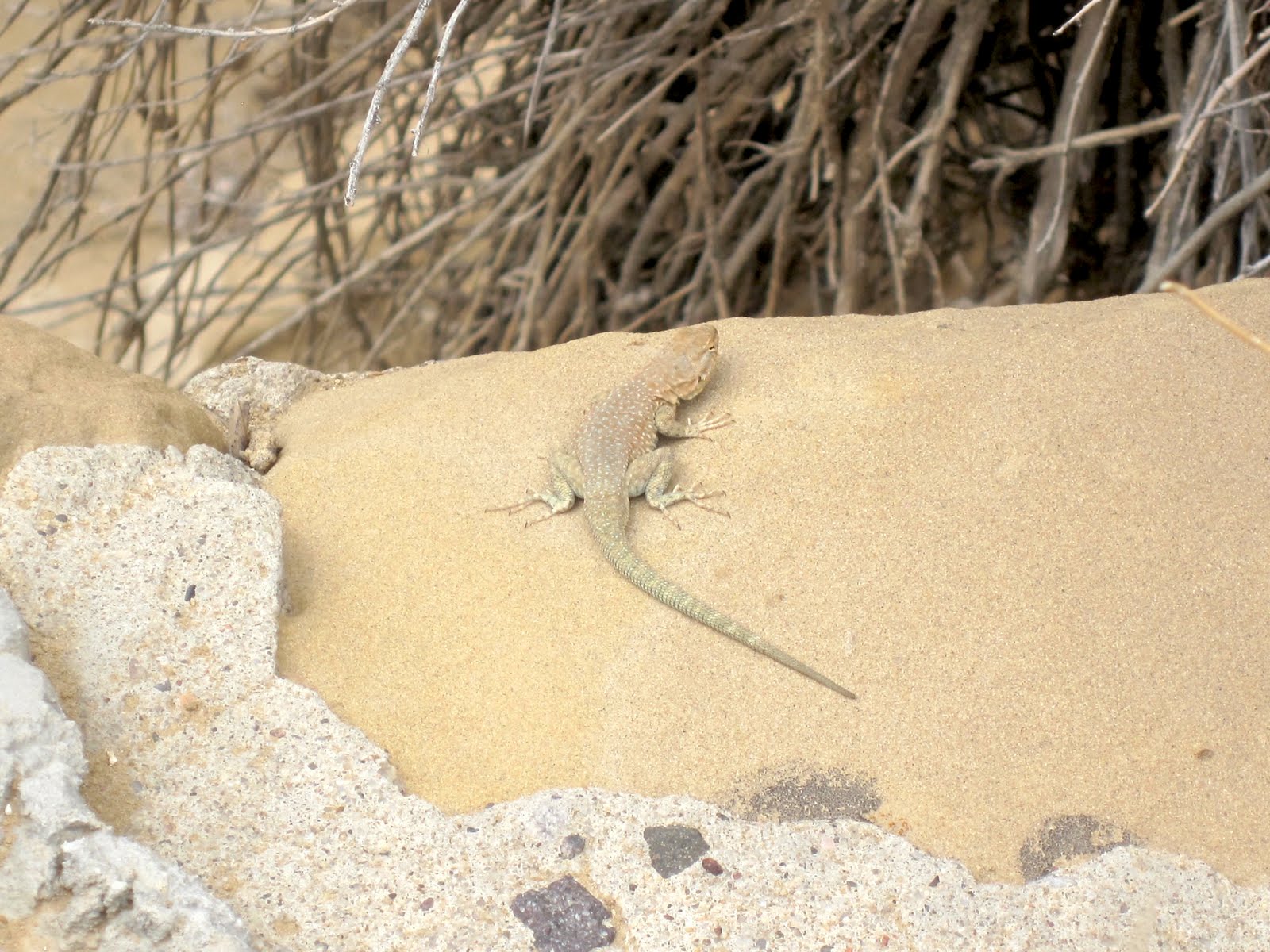
Because this area is very dry, there isn't a lot of wildlife in the area,
but we did see a fairly large number of lizards.
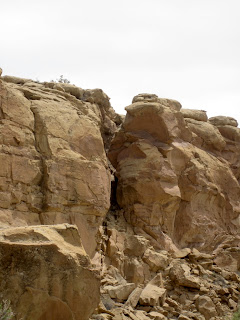

At the beginning of the day, we had bold ambitions. The boldest of
which was hiking the Pueblo Alto trail. This would mean hiking up
the cliff side (the difficult part) and then hiking across the top of the
cliff side to overlook Pueblo Bonito and visit the Pueblo Alto complex.
Wait...not so fast. When we got there, we looked at the climb...steep,
but not un-doable. It also included a VERY narrow section where one
has to squeeze through between several huge sections of rock.
We started up and found the trail to be very rough. It hardly qualified
as a trail at all. We took a quick vote and decided to save it for a time
in which the trail might be improved. Rest assured Mom...your youngest
child isn't a complete idiot!
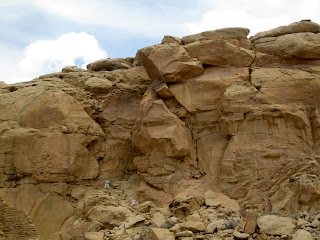

As we were headed back to the car, we saw this couple scrambling
up the cliff side and decided we had made the right decision.


With our hiking for the day completed, we had the option of checking
out other pueblos, going back to the campsite to read (me) or knit
(Lynn). Instead, we decided to exit out the south end of the park
toward the Navajo town of Crownpoint. The sign warned that the
road would be rough. Ha! it wasn't lying, As rough as the road is
entering the park from Nageezi in the north, this road was much
more wash-boardy.


However, there were lots of beautiful views available.


I'm pretty sure we were never "quite" on this angle while driving the
road, but it certainly felt like it sometimes.


Along the way, we drove by a Navajo ranch that had a number of
jewelry items for sale "Self Serve". A few little signs near each piece
asked people not to steal them. It's interesting that people would
actually think of doing so.


We came to a sign that left us scratching our heads. Were we headed
to Heaven...or Hell?


I was interested in visiting Crownpoint. For one reason, it is one
of the few areas of the Navajo Nation that we haven't visited and
I also grew up near the town of Crown Point, in Indiana. The town's
name was definitely where the comparison ended however. it's not
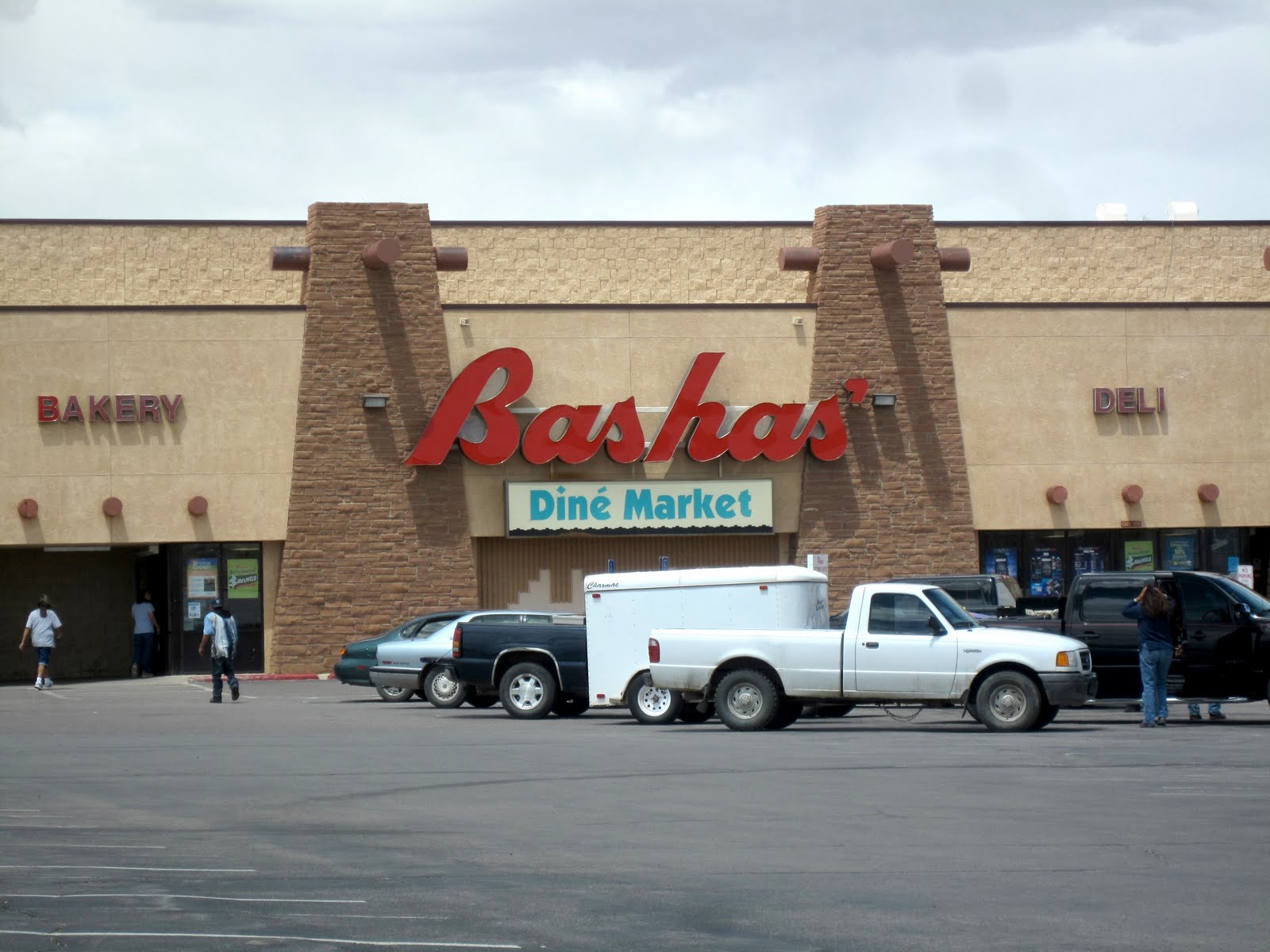
a bad little town. Just very remote and much much smaller. We
stopped at Basha's (a southwestern-based grocery chain that has
locations in lots of the larger Navajo Nation towns such as
Kayenta, Ganado, Window Rock, etc.).


The southwest is known for it's dinosaur relics, but we didn't think
we'd see one on this trip! Maybe it's even the remnants of a dragon.
Albeit a happy one!


We did a bit of stargazing before bedtime. One of the reasons we came
during this time period is that we knew there would be a new moon and
this is one of the most remote areas in the Lower 48 to view stars.
There is very little light pollution. Unfortunately, there were also more
clouds that we would have liked and way more wind than we would have
liked. It made for a short sky-watching evening. Fortunately, we had a
nice fire and it made for a cozy evening.

Saturday, April 24, 2010

Happy Birthday Hubble!


Today is the 20th Anniversary of the launch of
the Hubble Telescope! We can see so many things
in deep space today thanks to the Hubble. It
won't be in use twenty years from now, but it's
certainly paved the way for even bigger and
better telescopes!

Monday, July 20, 2009

One Small Step


40 Years ago today, Mankind first landed on the Moon.

Sunday, July 19, 2009

Apollo


I've always enjoyed this print as it features every member of
each Apollo mission, including the three members of the
ill-fated Apollo 1, who perished in a launch pad fire.
(Especially fellow Hoosier, Gus Grissom).

Saturday, July 18, 2009

Power


I was only 3 years old when the Apollo 11 Saturn V left the
launch pad this week 40 years ago, but I definitely remember
the last Moon launch of Apollo 17 in 1972. My best memory is
not of the Moon walks themselves, but of the Saturn V leaving
the launchpad. I still get chills watching the U-S-A crawling
up the screen as the rocket climbs off the pad.


"It stood 363 ft. tall--60 ft. taller than the Statue of Liberty--when
the Apollo spacecraft was sitting on the launchpad. When fully loaded
with propellants, the rocket weighed 6.2 million pounds. It had more
than 3 million parts. At full throttle, its five first-stage engines produced
a thundering 7.6 million pounds of thrust at liftoff. All told, a Saturn V
churned out more power than 85 Hoover Dams or, if you prefer, enough
energy to light up New York City for 75 minutes".

Sunday, March 01, 2009

Crash...Boom...Bang


If it weren't for Google News, you'd never hear about stuff
like this. A failed satellite launch crashed near Antarctica:

WASHINGTON, Feb. 24 (Xinhua) -- A rocket carrying a NASA
satellite designed to globally track carbon dioxide emissions
crashed into the ocean near Antarctica after launch Tuesday,
officials said.

The Orbiting Carbon Observatory failed to reach orbit after its
early-morning launch from California's Vandenberg Air Force
Base, the U.S. space agency said.

Preliminary evidence showed that the fairing on the Taurus XL
rocket failed to separate, preventing it from reaching orbit.

The fairing is a clamshell structure that encapsulates the
satellite as it travels through the atmosphere.

The spacecraft landed near Antarctica in the ocean, John
Brunschwyler, project manager for the Taurus XL, told a media
briefing.

A Mishap Investigation Board will immediately be convened to
determine the cause of the launch failure, a NASA press release
said.

The 278-million-U.S.-dollar spacecraft was slated to launch into
a near-polar, sun-synchronous orbit that would fly about 705 km
above Earth. It was going to measure carbon dioxide in the atmosphere
and to determine what happens to the climate-changing pollutant.

Before the launch, NASA said data from the observatory would reduce
uncertainties in forecasts of how much carbon dioxide is in the
atmosphere and improve the accuracy of global climate change
predictions.

Carbon dioxide is the leading human-produced greenhouse gas driving
changes in Earth's climate.

Tuesday's failure comes a month after Japan successfully launched the
world's first satellite to monitor global warming emissions.

Tuesday, May 27, 2008

The Moon and Jupiter


With our lack of sunshine, the Moon can light up the
ice sheet, almost giving the appearance of daylight.
Our "Midday Moon" as Lynn likes to call it is a friendly
reminder of Sun, long gone from our sky. This year though,
it seems that the Moon has a companion. Jupiter and the
Moon seem to chase each other across the sky and with
some good binoculars, you can actually see four of Jupiter's
own moons; Ganymede, Callisto, Io, and Europa. A few years
ago, Mars was at it's closest distance in years to the Earth
and it was a friendly presence in our sky every day. This
year, Jupiter seems to have taken it's place.

Friday, May 16, 2008

No Sunspots


This is one of those times I'm trying to jinx myself.
We haven't had good auroras all year so I thought I
would write about having no auroras. Sure, we had
some white ones and some fair ones a few Sundays
ago. However nothing compared to the auroras we
experienced last May. To have good auroras, you
typically need sunspot activity on what else...The
Sun. There's been hardly any sunspot activity
lately. This oval that you see should be very bright
red. It's not looking very red...just yellow. So
today I volunteered to host some aurora-sighting
trips up to the Arrival Heights area in the next
few months. My thought process is kind of like washing
your car, hoping for rain. Writing about the lack
of auroras, hoping for them to appear. Maybe...
Could be...probably not.

Wednesday, May 07, 2008

Dark Days Ahead

Click On Photos To Enlarge

2008


2007


The photos above were taken by Bill, the NSF Station Manager
this May (top two photos) and last May (bottom two photos).
Even though we turned off quite a few lights last year to
conserve energy, this year we've probably turned off twice
as many and it's very obvious when comparing the photos. I
for one am very happy since I am a Dark Sky proponent and we
will see many more stars and auroras here in town. There
are some who would rather turn on all of the lights but I
think it's more how Antarctica should be and not just some
big town on the edge of the wilderness. Safety does however
play a big part of our lives down here and I concede that we
need to have a fair share of lights on so people will not
hurt themselves. For the next few months, this will be our
view when looking over McMurdo as the Sun is long gone and
even the very dim twilight at midday will be gone in less than
a week. However, with the lights vastly dimmed, I'm
looking forward to some fantastic sky shows this winter!

Tuesday, May 06, 2008

That Time of Year Again


Our friend and aurora-photographer-extraordinaire Antz took
these great photos on Sunday night of the season's first
really good auroras. Typically they're not very visible
here in town, but these were really bright and they happened
around midnight when it's darkest.


Of course I missed them. Lynn was having trouble sleeping
and got up. She told me that there was some really good
auroras visible so I staggered to the window, didn't see
any and went back to my coma-induced sleep. I'm sure there
will be other opportunities in the next few weeks to see
some really bright ones here in town.

Wednesday, April 23, 2008

Farewell Good Friend


Today was the both the last sunrise and sunset of the
season. We won't see the Sun anywhere near McMurdo
again until late August. It's interesting that this
last sunset comes and goes and no one really pays
attention to it. No ceremony, no speeches, no recognition
of any kind. There are no native peoples and never have
been in Antarctica so there's no record of anything
"tribal" occuring here either. I guess you would have
to talk to the Inuit or Lapps or some other group from
the far north to get the same feeling of what they did
throughout history. As long as the Earth maintains its
tilt mechanism and the Sun still exists in it's present
form, the Sun will return to our skies. It will be missed
however. I hope so. Somehow I think it might be miffed
(or at least disappointed) that we didn't do anything to
mark it's departure.

Monday, March 31, 2008

Satellite Skies


It's getting pretty dark at night now and staying dark
throughout the early morning hours. So dark, that the
sky was full of stars...and satellites this morning when
I went to work a few minutes before 6:00. As I was walking
into Building 165, I looked up to locate the Southern Cross.
I found it almost immediately and at that moment, a satellite
was going right through the middle of it. Not really through
the middle obviously, but from here on the ground, it
certainly looked that way. I'd just seen my first satellite
of the season and I later identified it as the Cosmos 405.
It's a Russian Tselina D model, in a polar orbit for
"observation" purposes. Hmmm. Regardless of it's purpose,
it's launch date was April 7, 1971. Almost 37 years ago
to the day! I'm hoping to see a lot more satellites this
season. We'll just need some clear skies.

Play Ball!


I've been thinking about baseball this week. A lot!
The major league season starts this week and I hope...
yes I really hope, that this is my team's year. I've
put a whole lotta faith in the Cubs winning it all
this year. Last year's disappointment in the playoffs
taught me nothing. I fear I'm setting myself up for
more disappointment. I fear that a World Series
Championship is a very long distance away from me.
It only seemed fitting that I ran across this really
cool map comparing the size of the Apollo 11 landing
site to a typical baseball diamond. We fly 238,854
miles to land on the Moon and our exploration area
is a barely a line drive into the Right Field Gap!
We haven't been back to the Moon in 39 years. The
Cubs haven't won the big one in 99 years. Although
I'm baffled that we haven't been back to the Moon
since, I hope the Cubs win the Series before we go
back to the Moon. NASA employees will have to look for
employment elsewhere...I'm feeling greedy.